

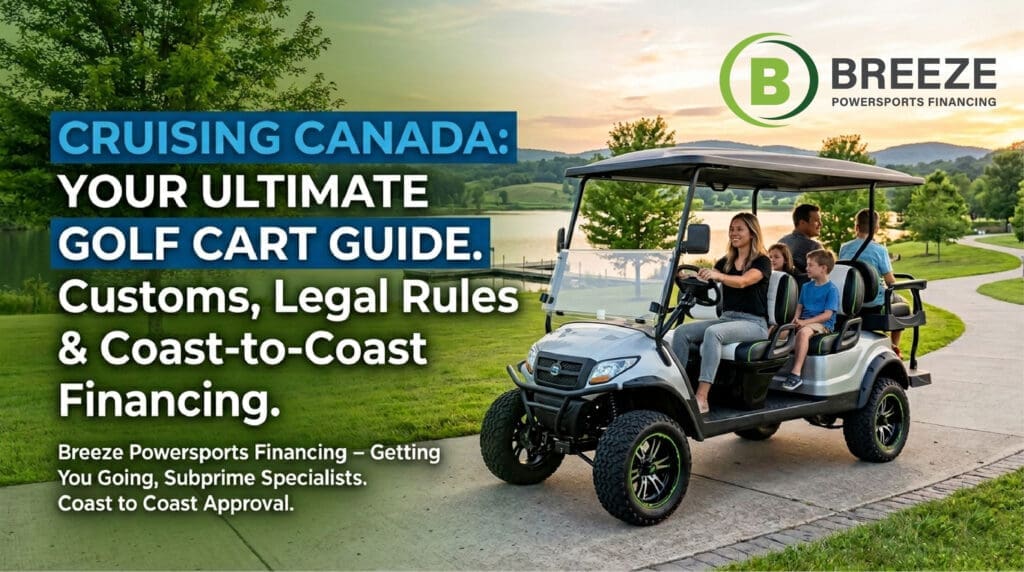
If you’ve spent any time at a campground, cottage community, marina, or master-planned neighborhood lately, you’ve probably noticed a major shift. The humble golf cart has officially broken out of the golf course.
Across Canada, golf carts—now frequently called low-speed vehicles (LSVs)—have evolved into an essential part of the Canadian summer lifestyle. They are being used as secondary family runabouts, campground workhorses, and crucial utility tools for small businesses.
But buying a golf cart in 2026 isn’t quite as simple as it used to be. High-end custom builds, modern lithium batteries, and changing provincial regulations mean there is a lot to consider before you sign on the dotted line.
Whether you are looking for a lifted 4-seater for the family cottage or an entire utility fleet for your commercial property, here is your ultimate guide to buying, legalizing, and financing a golf cart in Canada this season.
The Technology Shift: Lithium-Ion vs. Traditional Lead-Acid
The days of slow, heavy, high-maintenance golf carts are quickly fading. One of the biggest trends driving adepts right now is the massive shift toward lithium batteries.
- Traditional Lead-Acid Batteries: These remain the budget-friendly choice upfront, holding a solid share of the commercial fleet market. However, keep in mind it will require periodic care – like regular water top-offs. Additionally, as the battery drains, voltage drops may occur, and you will need a replacement every 3 to 5 years.
- Lithium-Ion (LiFePO4): While more expensive upfront, lithium is rapidly becoming the gold standard for personal use. They require zero maintenance, charge fully in just 2 to 4 hours, maintain full power until empty, and boast a lifespan of up to 10 years.
Investing in a lithium-powered cart adds to the upfront sticker price, but it can reduce the overall ownership cost and save you money on replacement batteries.
Navigating the Rules: Is Your Golf Cart Street-Legal?
Can you legally drive a golf cart on public roads in Canada? The short answer is: It depends entirely on your province and your municipal bylaws.
Provinces across the country have introduced pilot programs and frameworks to manage how these vehicles interact with public roads. Because rules change fast, it’s critical to know your local regulations before hitting the pavement.
Provincial Road Rules at a Glance
Province | On-Road Regulatory Status | Key Requirements & Limitations |
Ontario | 10-Year Pilot Framework (Select Regions) | Allowed in participating municipalities on roads with speed limits up to 50 km/h. Requires seatbelts, horn, lights, mirrors, an odometer, and a windshield defogger. |
Alberta | Municipal Pilot Programs | Generally restricted to designated municipal roads. Drivers must be 14 or older, operate during daylight hours only, and stay on roads with limits under 50 km/h. |
Saskatchewan | Allowed via SGI-Approved Bylaws | Municipalities can pass bylaws allowing carts on public roads. Requires a minimum Class 7 driver’s licence, $200,000 in liability insurance, and a slow-moving vehicle sign. |
Colombie britannique | Restricted Resort & Neighborhood Zones | Allowed only on designated roads in specific master-planned communities or resort towns. Vehicles must be registered, insured, and restricted to daylight hours on roads up to 30 km/h. |
⚠️ Important Note: Even if your province allows golf carts under a provincial framework, your specific municipality must pass a local bylaw to legalize them on your town’s roads. Always check with your local town hall or township office first!
Personal Customization vs. Commercial Fleets
The way Canadians use golf carts generally falls into two distinct categories, both of which require a different approach to buying:
The Leisure & Cottage Market
For personal use, customization is king. Buyers are looking past basic white carts and opting for 6-inch factory lift kits, aggressive all-terrain tires, custom matte paint jobs, premium leather seats, and built-in Bluetooth soundbars. A modern 4-to-6-seater custom cart is built to be a true extension of your weekend lifestyle.
The Commercial & Utility Market
For small businesses, resorts, campgrounds, orchards, and industrial spaces, a golf cart is a piece of working equipment. The focus here is on utility: rugged flatbeds, heavy-duty cargo boxes, or multi-passenger shuttle configurations. Financing a commercial fleet allows business owners to preserve their hard-earned operating cash flow while getting the equipment they need to scale operations before the busy season hits.
How to Finance a Golf Cart in Canada (Even with Less-Than-Perfect Credit)
Between rising manufacturer costs, custom modifications, and premium lithium battery packs, a quality golf cart can easily range anywhere from $6,000 to over $18,000.
For many Canadians, paying cash upfront isn’t the best option—or even a possibility. If you’ve faced financial hurdles in the past, like a consumer proposal, bankruptcy, or a bumpy credit history due to a life event, walking into a traditional bank for a powersports loan can feel incredibly stressful.
That is exactly where Breeze Powersports Financing comes in.
We are subprime financing specialists operating coast-to-coast across Canada. We believe that a past credit score shouldn’t dictate your current lifestyle or hold your business back. We look at your overall financial stability and current situation to build an affordable loan path that fits your budget.
Even better, a small, manageable powersports loan on a leisure vehicle or utility cart is a fantastic, low-stress way to start rebuilding your credit profile.
Estimate Your Payments
Curious about what your budget might look like? Hit “Start My Application” to understand available rates, get a payment structure that fits your needs, and to boost your summer plans with a golf cart that can serve both leisure and business goals.